Designing the Kamoji helmet from scratch
By March 2026, Kamoji's inner structural frame was more or less settled. The next problem was one nobody on the team had any experience with at all: industrial design.
The bar we set
We're used to designing technical components — PCBs, structural frames, sensor mounts, assembly tolerances. None of that translates to designing a product's outer form: curved surfaces, a silhouette that communicates personality, a shape that invites touch. That's a different discipline, and we had none of it going in.
The requirements were deliberately demanding. The helmet needed to be timeless rather than a trend that dates itself in two years. It needed to read across cultures and age groups. It had to be clearly its own thing, not a derivative of a competitor's shape. It had to be swappable, the way competing products let you customise the shell. And — for the maker and open-source angle — it had to be printable on an entry-level consumer 3D printer, no exotic materials or equipment required.
Where external designers didn't work, and where sketches did
We brought in external industrial designers to explore concepts first. It didn't go well — the results either missed the timeless, cross-cultural brief, the character didn't read right, or the geometry didn't work with the inner frame's physical constraints. We came away with a clear list of what we didn't want, which is something, but not what we needed.
The actual breakthrough came from hand-drawn sketches on paper, fed into AI image generation tools to produce polished visual concepts from the rough gesture of each sketch. It worked immediately — a range of directions to react to and choose between, at a pace no single designer could match on their own.
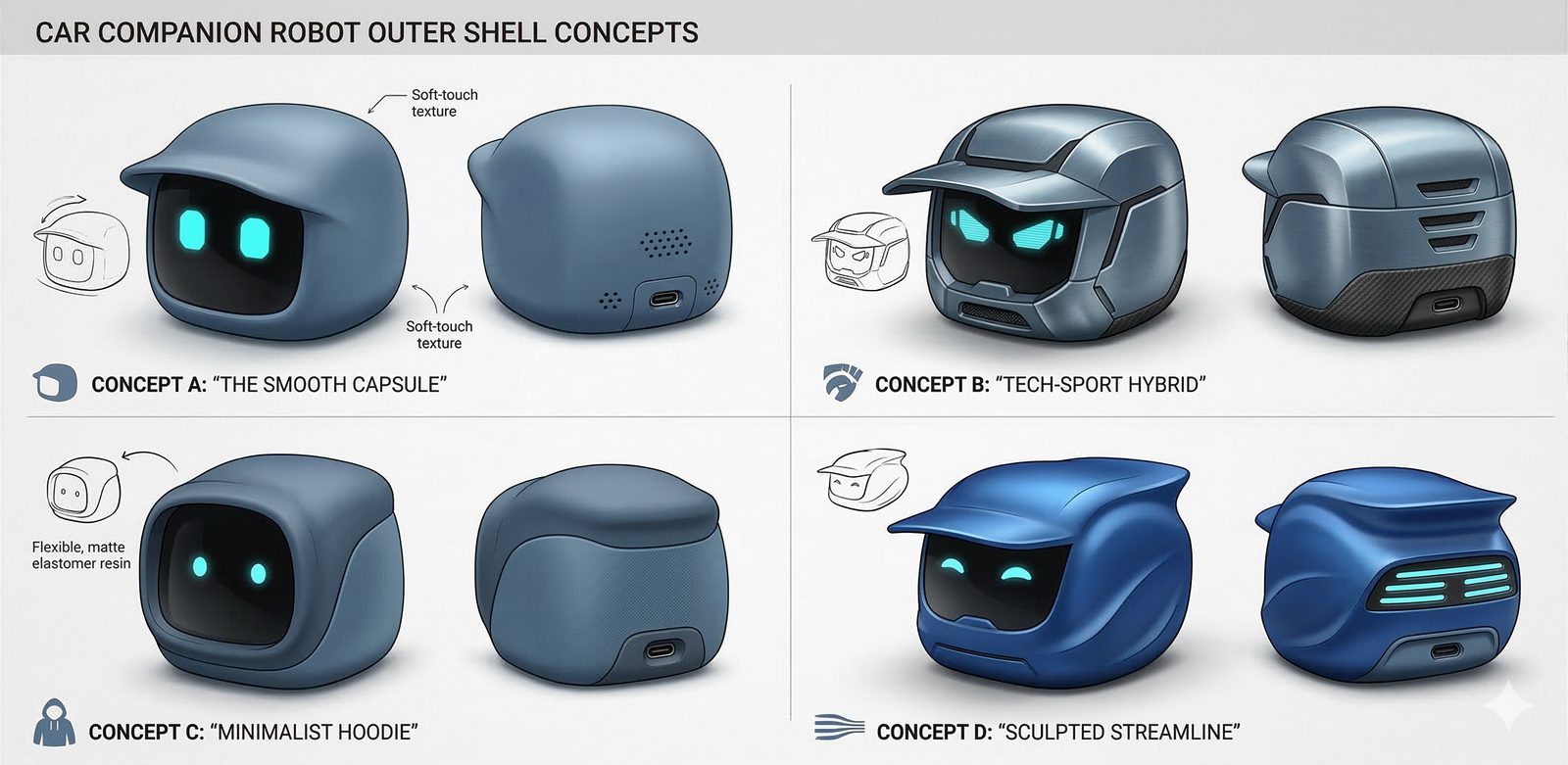
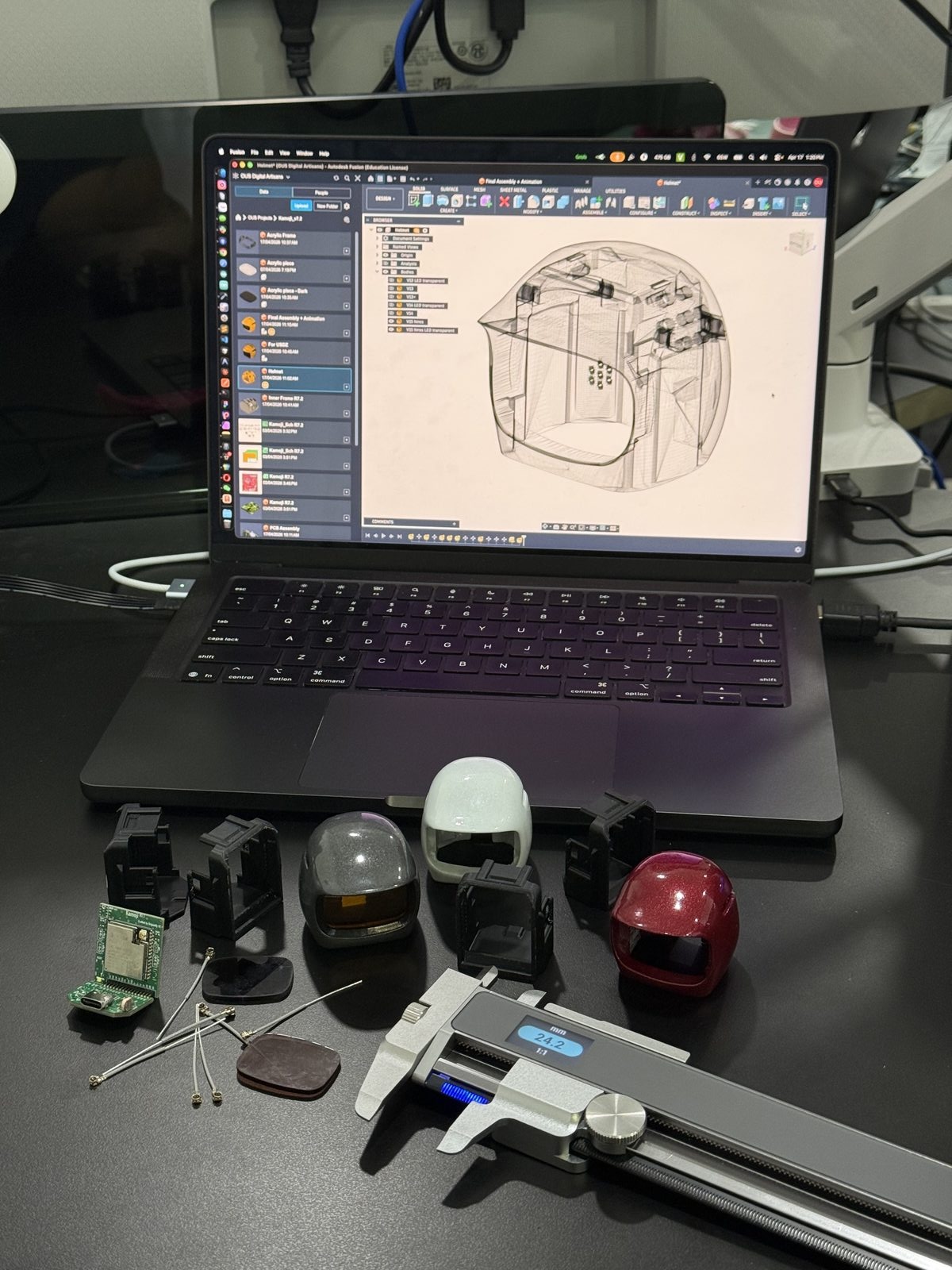
Concept images aren't CAD models, though — no tolerances, no wall thicknesses, no assembly logic. The next step was a human designer taking the chosen direction and turning it into real geometry: a file we could pull dimensions from, iterate on, and eventually send to a printer.
Kodo as the filter
For the CAD refinement stage, we used Mazda's Kodo — Soul of Motion design philosophy as a reference: no sharp edges, surfaces that flow into each other, lines with direction and tension, as if caught mid-movement. Every decision in refinement ran through that filter — a hard transition got softened, a line that broke the flow got rethought. Having a named design language to check against kept the iteration focused instead of open-ended.
Fitting the shell to what's inside it
The visual design being finalised was only part of the problem. The helmet also had to physically fit over the inner frame, align with the display window, and click into place with a precise, satisfying snap. That took its own round of iteration — print a prototype, check the fit, adjust tolerances, print again. Most prototypes had at least one thing wrong. Each one told us something.
Everything was finalised in May 2026, about two months after the industrial design work started.
This is the fifth post in a series on how Kamoji got built. Next: scaling from 200 hand-checked units to a manufacturing partner, and what changed along the way.